Why I Built an Ecosystem Instead of One Personal Brand
One reputation can connect many focused worlds without forcing every idea into the same box.
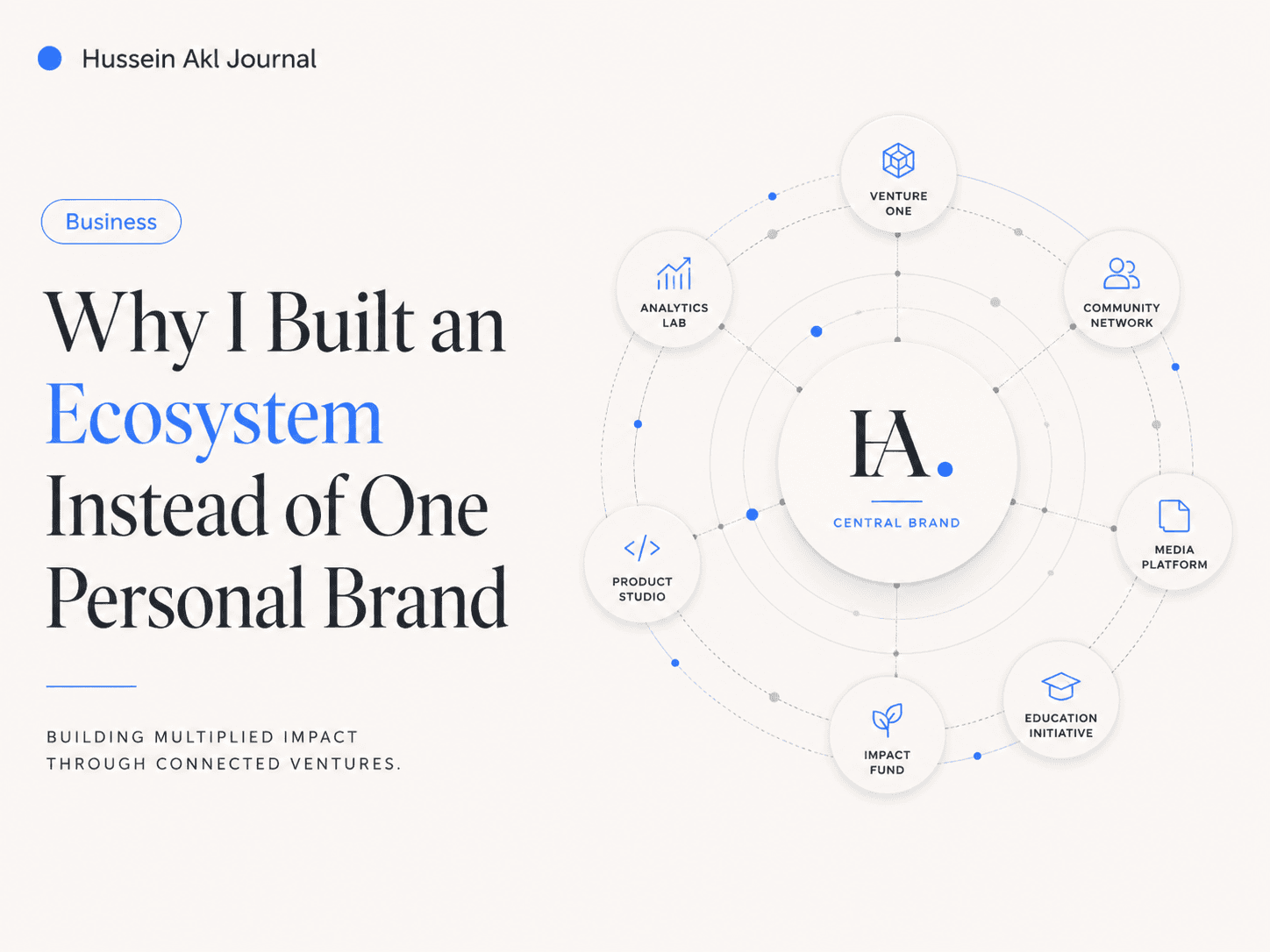
For a long time, I assumed growth meant putting more things under one name. The more I built, the more that assumption stopped working. A studio, a Notion business, software products and personal work can share a point of view without pretending to be the same thing.
The problem with one giant bucket
A personal brand is powerful because it accumulates trust. Every project, article and result can reinforce the same reputation. But that strength becomes a weakness when the brand starts carrying too many unrelated expectations.
If someone arrives because they need branding work, they should not have to decode a product catalogue. If someone wants a Notion template, they should not need to understand a creative studio first. If someone is interested in a small software tool, the product should be able to explain itself without depending on my biography.
That was the tension I kept running into. I wanted the work to benefit from one reputation, but I did not want every project to look, sound or behave as if it belonged to one company.
The ecosystem model
The answer for me was not to split everything apart. It was to create a clearer hierarchy.
My personal identity sits at the center. It carries the long-term story: what I care about, what I am learning, what I am building and how the different pieces connect.
Around that are focused worlds. HA Creatives can be a creative studio. HA Notion can stay specific to Notion systems and products. HA Nexus can become the home for software and AI-assisted products. Individual tools can then have their own names and identities without losing their connection to the larger body of work.
The point is not to create more brands for the sake of having more brands. The point is to reduce ambiguity.
Shared principles, different jobs
A useful ecosystem needs two things at the same time: connection and separation.
Connection comes from shared principles. The work should feel like it came from the same way of thinking. The standards for clarity, usefulness, craft and honesty should travel across the whole system.
Separation comes from purpose. Each world needs a reason to exist that another world cannot easily absorb.
That distinction matters. If two brands perform the same job for the same audience with the same offer, the architecture is probably adding complexity instead of removing it.
Why the personal brand stays central
I do not want the parent identity to behave like a holding company. That would make the system feel larger and more corporate than it really is.
The personal brand is useful precisely because it is human. It gives context to experiments. It allows me to write about a design decision one day and a product build the next without pretending those things belong to the same commercial offer.
It also creates continuity. Projects can change, products can be retired, and businesses can evolve, while the central story remains intact.
The practical benefit
The biggest benefit is decision-making.
When a new idea appears, I can ask where it belongs before I ask what it should be called. Is it a client service? A standalone product? A personal experiment? A resource? A piece of writing?
That one question prevents a lot of unnecessary brand creation.
It also helps with communication. A person can enter the ecosystem through the thing most relevant to them, then discover the wider system later.
The risk: too much architecture
There is a danger in this model. It is easy to become more interested in organizing the ecosystem than in making useful things.
I try to use a simple rule: structure should follow real work. A new world earns its place only when there is enough substance behind it to justify a separate role.
A diagram is not a business. A name is not a product. A logo is not a reason to exist.
What I want the system to become
The long-term goal is not to make every part of the ecosystem equally large. It is to make every part understandable.
Some worlds may become meaningful businesses. Some may remain personal projects. Some products may grow while others stay small. That is fine.
The architecture gives each piece enough independence to become what it needs to become, while the personal brand gives the whole body of work a common memory.
That balance is what I was looking for: not one giant brand, and not a collection of disconnected projects, but an ecosystem.