Why Good Marketing Starts Before Content Creation
Content is execution. Marketing begins with the decisions that tell the content what it needs to do.
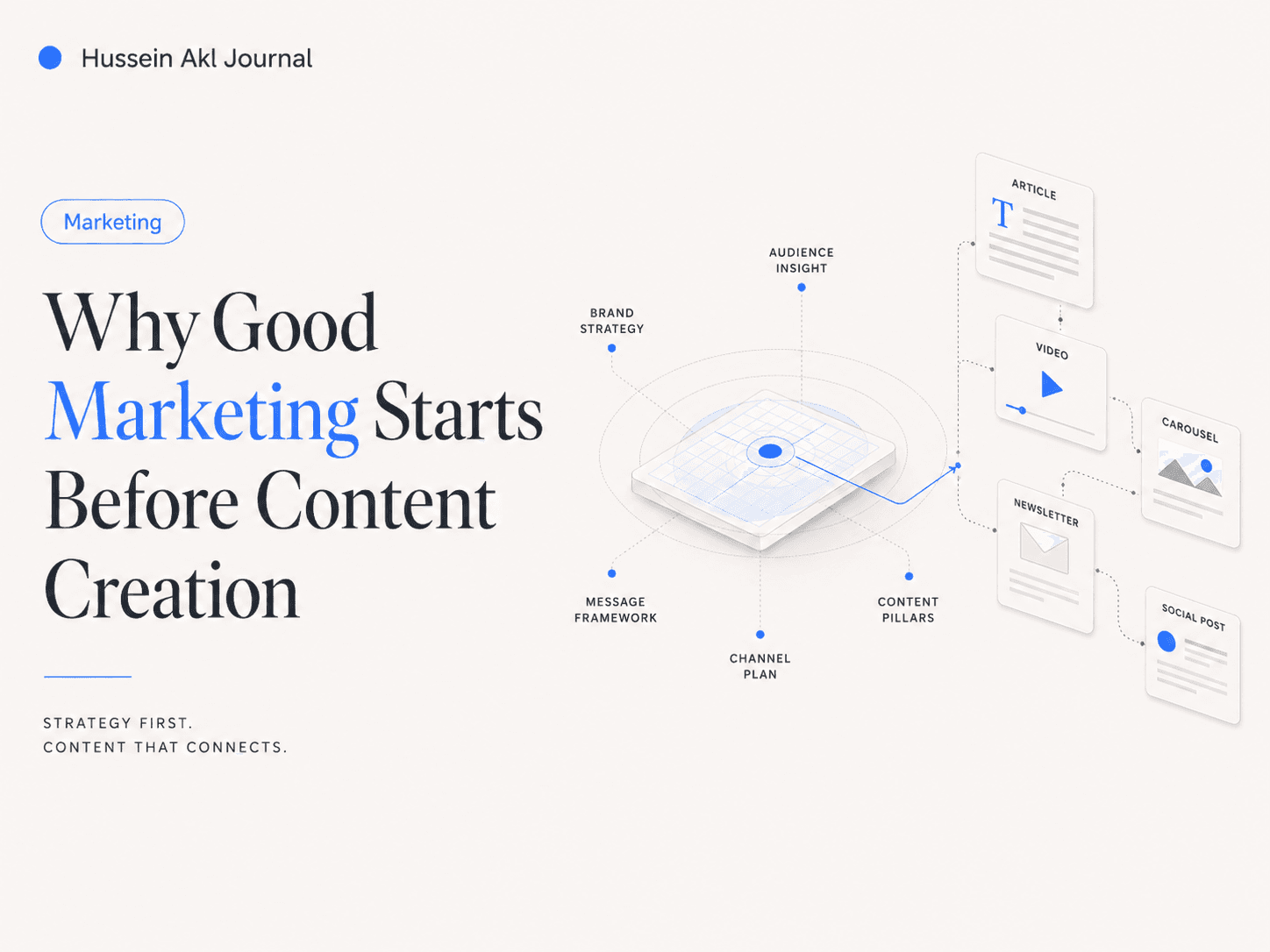
Content is visible, which is why it is easy to mistake content production for marketing itself. But by the time a post is being designed, some of the most important marketing decisions should already be made.
Content is downstream
A content calendar cannot fix unclear positioning.
A strong visual cannot compensate for a message that does not matter to the audience.
A clever caption cannot create differentiation that the offer itself does not have.
Content amplifies decisions made earlier.
That is why I prefer to think of content as one layer of marketing rather than the beginning of it.
Start with the audience problem
Before choosing formats or channels, I want to understand what the audience is actually trying to solve.
That sounds obvious, but teams often jump directly to topics.
A topic is not a problem.
“Branding tips” is a topic. “I have a good business but my presentation makes it look inconsistent and cheap” is closer to a problem.
The second version gives the content something useful to address.
Clarify the position
The next question is why the audience should listen to this brand instead of another one.
Positioning does not need to become a dramatic manifesto.
It can be a clear combination of audience, problem, point of view and proof.
Without that foundation, content tends to become generic because it has no strategic boundary.
Decide what the message must achieve
Different content has different jobs.
Some content should create awareness. Some should explain. Some should reduce risk. Some should demonstrate expertise. Some should convert. Some should keep the brand familiar.
If every piece tries to do everything, the content becomes crowded.
I prefer to give each piece one primary job.
Build pillars from strategy, not convenience
Content pillars are useful when they represent recurring strategic themes.
They are less useful when they are simply categories that are easy to post.
A strong pillar should connect the audience's questions to the brand's expertise and commercial direction.
That creates repetition with purpose.
The brand becomes known for a set of ideas instead of an endless stream of unrelated posts.
Choose channels after the message
Different channels reward different behavior.
A long-form article can develop an argument. A short video can demonstrate a quick insight. A carousel can structure a visual explanation. Email can build an ongoing relationship.
The channel should shape the expression, not determine the strategy.
If the message only exists because a platform format is trending, it is usually fragile.
Production should make the strategy visible
Once the strategic decisions are made, creative production becomes easier.
The designer knows what should be emphasized. The writer knows what claim matters. The editor knows what can be removed. The person publishing knows what action the audience should take.
Good strategy reduces creative confusion.
It does not make the content boring. It gives creativity a useful constraint.
Measure the job you assigned
The final mistake is judging every piece by the same metric.
If a post was designed to explain a complex idea, saves or time spent may matter more than immediate enquiries.
If a landing page is intended to convert, clarity and conversion matter more than reach.
Measurement should reflect the job.
The sequence
My preferred sequence is simple:
- Understand the audience problem
- Clarify the position
- Define the message
- Build strategic content pillars
- Choose the right channels
- Create the content
- Measure it against its intended job
Content creation is important.
But it becomes much more effective when it is the result of marketing decisions rather than a substitute for them.