Why Every Creative Needs a Backlog
A backlog gives ideas somewhere to live without forcing every interesting thought to compete for attention immediately.
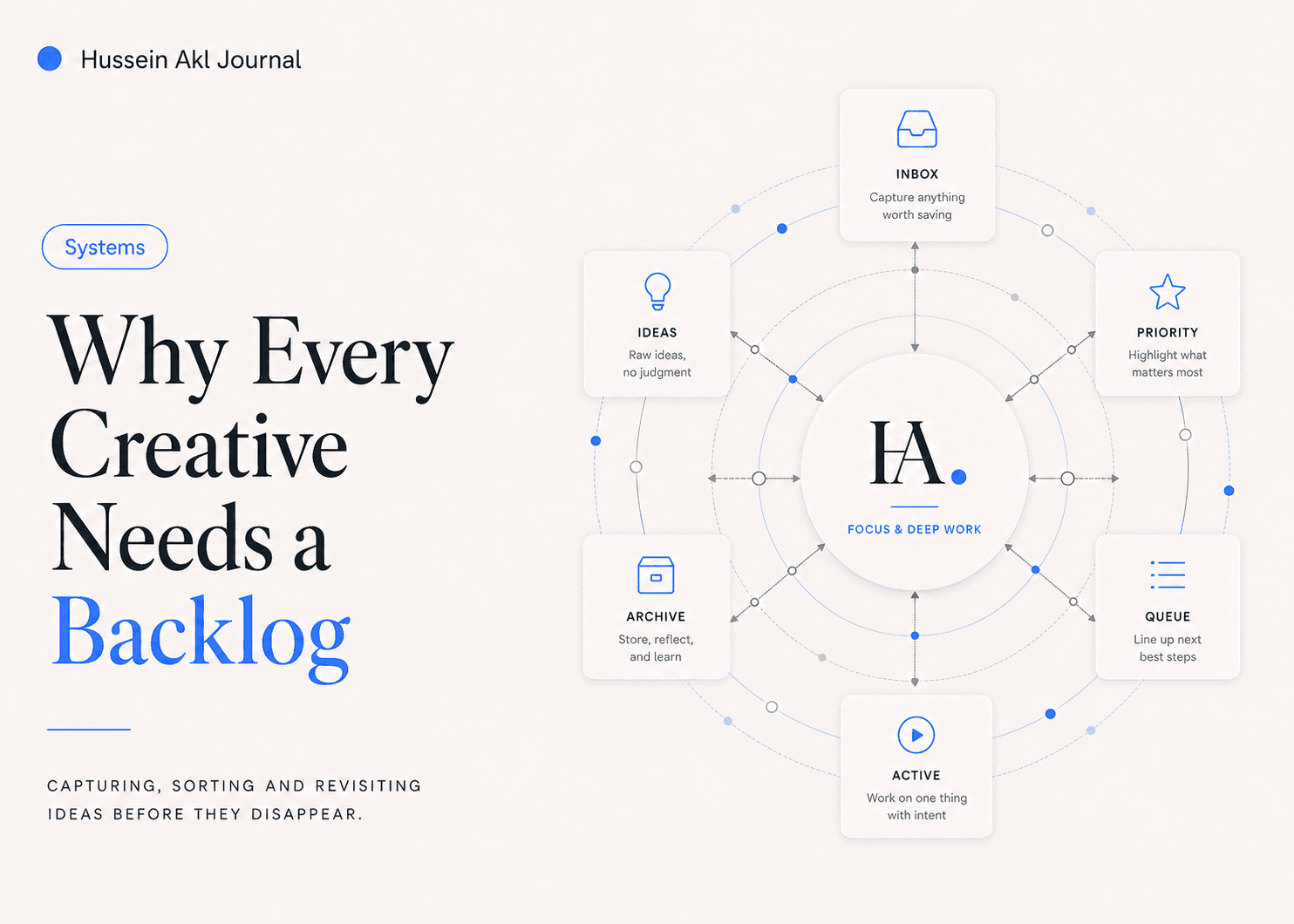
Creative people rarely suffer from a shortage of possible things to do. The problem is deciding what deserves attention without losing the ideas that do not deserve attention yet.
The backlog removes urgency from ideas
A new idea often feels urgent because it is new.
Writing it down changes that.
The idea now has somewhere to exist without becoming a project.
That small separation protects focus.
I do not have to build the idea to avoid losing it.
Ideas and commitments need different states
An active project has obligations.
An idea has possibility.
If they live in the same list, the system treats them as equally important.
That creates unnecessary pressure.
I want active work to represent what I have actually decided to do.
The backlog represents what I may choose later.
Capture should be fast
The backlog should not require a complete business case.
I capture enough to recover the idea:
- Working title
- Problem
- Possible user
- Why it caught my attention
- Useful references
- Related project or world
The idea can become more detailed if it survives review.
Review creates value
A backlog that is never reviewed becomes storage.
The useful part is revisiting it.
Some ideas keep returning. Some become more relevant because another project created infrastructure. Some become unnecessary because a different solution appeared. Some stop feeling interesting entirely.
Time becomes part of the validation process.
I promote ideas deliberately
An idea should not become active only because I feel excited about it today.
Promotion from backlog to project should require a reason.
Why now? What problem does it solve? What will I stop or delay to create space? What is the smallest useful version? How does it fit the larger direction?
That step turns possibility into commitment.
Archive without guilt
A good backlog also needs an archive.
Old ideas can become noise if they remain permanently visible.
Archiving does not mean the idea was bad.
It means I no longer need it competing for attention.
The ability to remove is part of the system.
Backlogs create creative confidence
Knowing that ideas are captured makes it easier to stay with the current project.
I do not need to interrupt the work every time a better-looking possibility appears.
The idea is safe.
I can return to it later.
That creates a surprising amount of calm.
The backlog should stay lightweight
I avoid turning the backlog into a second project.
Too many scores, statuses and formulas can create fake precision.
For most ideas, I need simple information:
- What is it?
- Why might it matter?
- Where does it belong?
- Is it still worth considering?
Everything else can wait until the idea becomes real.
The real purpose
The backlog is not a warehouse of everything I could ever do.
It is a buffer between imagination and commitment.
It lets me stay curious without letting curiosity destroy focus.
That is why I think every creative person benefits from one.
Not because every idea deserves to be built.
Because most ideas deserve a place to wait while I finish what I already chose.