Why Constraints Make Creative Work Better
The right boundaries reduce noise, sharpen decisions and give creative work a clearer direction.
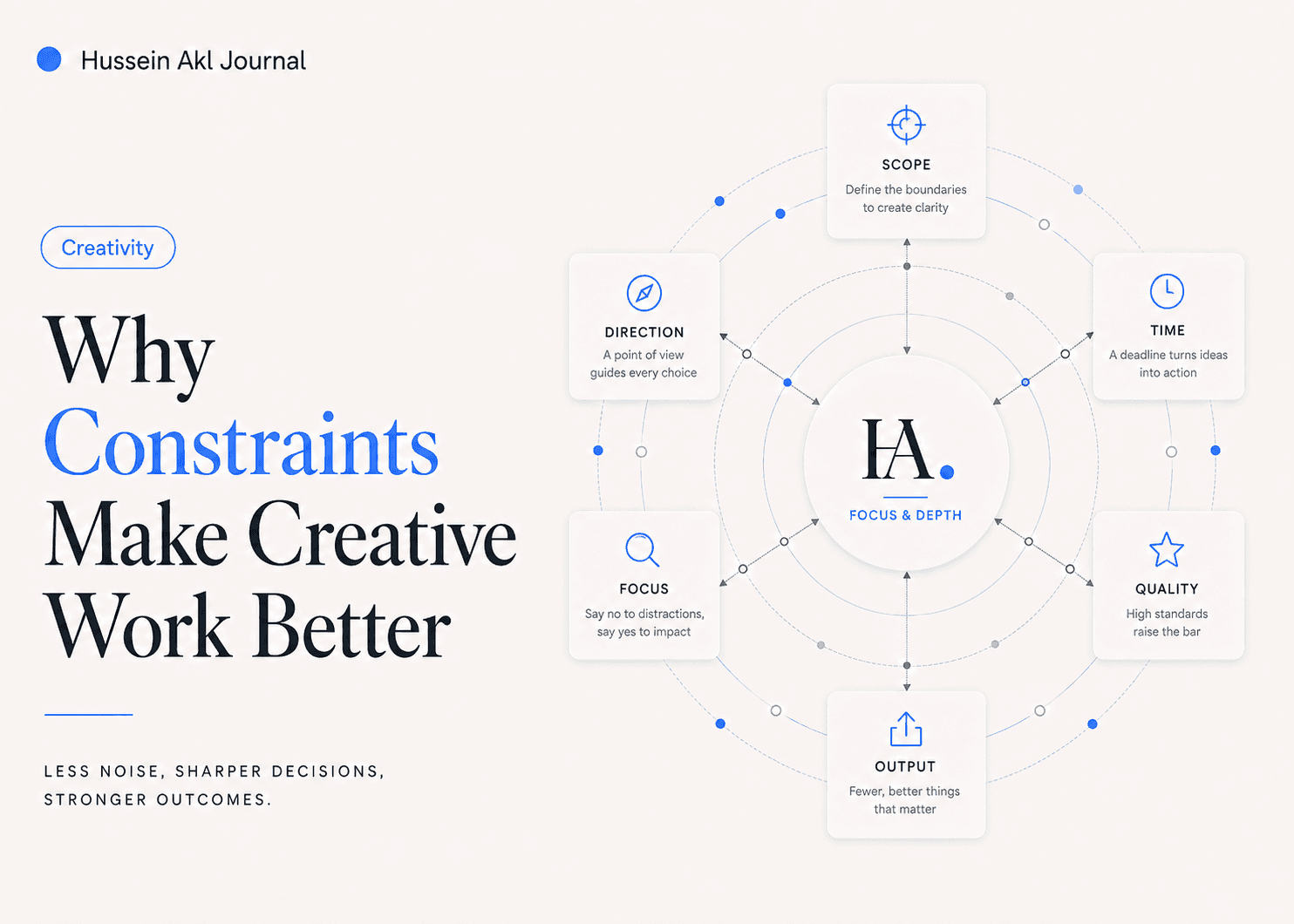
Creative freedom sounds ideal until every decision becomes possible. I have learned that strong constraints often produce better work because they remove choices that were never useful in the first place.
Unlimited choice creates weak decisions
When everything is possible, every decision has to be invented.
Which color? Which typeface? Which layout? Which format? Which audience? Which message? Which feature?
Creative work can become exhausting long before it becomes good.
Constraints reduce the size of the decision space.
That does not make the work less creative. It gives creativity something to push against.
Strategy is a constraint
A clear strategy immediately removes many bad options.
If a brand needs to feel precise, restrained and premium, some visual directions simply do not belong.
If a product exists to make one action faster, features that complicate that action are easier to reject.
This is why I do not see strategy as a document that sits before the creative work.
Strategy is one of the tools that makes the creative work possible.
Time can improve judgment
Deadlines are uncomfortable, but they force prioritization.
Without a deadline, it is easy to keep exploring because another version might be better.
With a deadline, I have to decide what matters most.
That pressure is not always healthy, and artificial urgency can damage quality. But a realistic time boundary creates a useful question: what deserves attention now?
Format creates focus
A poster, a landing page and a carousel are different creative problems because the format changes the rules.
A small canvas forces hierarchy. A short video forces pacing. A one-page site forces the message to become concise.
The format itself becomes part of the creative direction.
When I feel stuck, reducing the format often helps more than adding inspiration.
Scope protects quality
One of the most important constraints is deciding what the project is not.
A small product can be excellent at one thing.
A brand identity can focus on the touchpoints the business actually uses.
A campaign can communicate one central idea instead of trying to represent the entire company.
Scope creates the conditions for depth.
Constraints reveal the concept
A weak concept often needs decoration because it has no strong organizing idea.
A strong concept can survive reduction.
If I remove effects, extra colors and unnecessary copy, does the core idea still hold?
Constraints make that question visible.
They expose whether the concept is doing the work or whether the styling is carrying it.
The constraint should serve the outcome
Not every limitation is useful.
A constraint that exists only because “we always do it this way” can become a habit that damages the work.
The useful constraints are connected to a reason:
- Audience
- Brand position
- Technical reality
- Budget
- Time
- Format
- Accessibility
- Product promise
The point is not restriction for its own sake.
The point is better decisions.
What I do at the start of a project
I like to identify a small set of non-negotiables early.
What must the work communicate? Who must understand it? What cannot change? What can change freely? What is outside the scope? When does the decision need to be made?
Those answers create a frame.
Inside that frame, experimentation becomes faster because I know what I am experimenting for.
Creative freedom is still there.
It is simply pointed in a useful direction.