The System I Use to Keep Projects, Brands and Ideas From Becoming Chaos
The goal is not to capture everything. It is to know what deserves attention now and where everything else belongs.
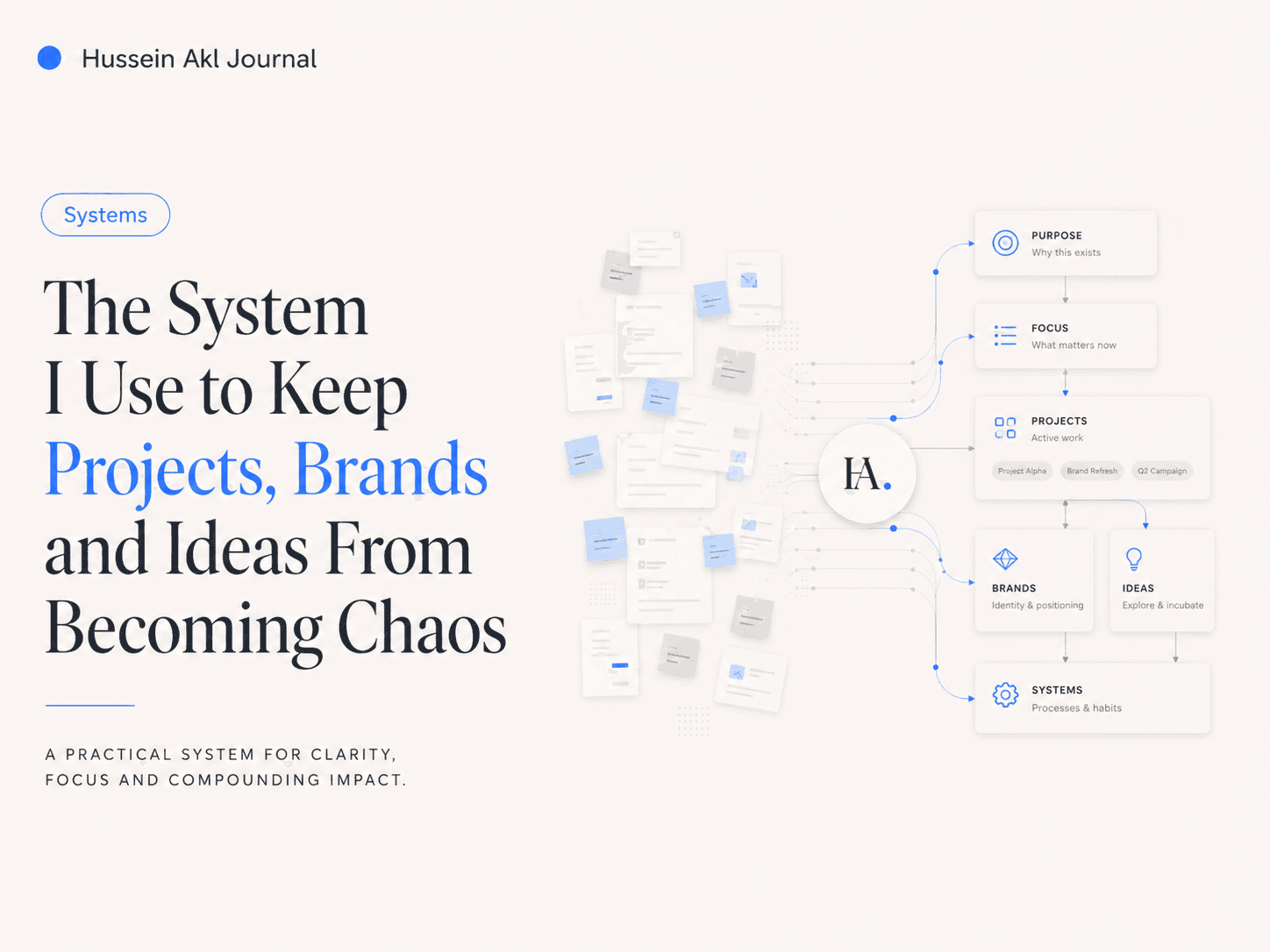
The difficult part of having many interests is not generating work. It is protecting attention. Without a system, every new idea arrives with the same apparent importance as the project that actually needs to ship.
I separate commitment from possibility
The first distinction in my system is between things I have committed to and things I could do.
An active project has a current obligation.
An idea has potential.
Those are not the same state.
When ideas live beside active work without a clear distinction, they compete for attention even though nobody has committed to them.
So I keep an explicit idea layer where possibilities can exist without immediately becoming projects.
Every active project needs a next meaningful outcome
A project can contain hundreds of tasks and still feel unclear.
I prefer to define the next meaningful outcome.
That might be:
- Submit the extension for review
- Finish the homepage
- Approve the identity direction
- Publish the first ten articles
- Test the production build
The outcome is larger than a task but smaller than the entire project.
It gives the work a visible direction.
Brands are context, not task lists
A brand is not something I can complete.
It is a context that contains projects, responsibilities, assets and recurring work.
Treating a brand as one giant project makes it impossible to know when progress has actually happened.
So I separate the world from the work inside it.
HA Creatives can exist continuously while a specific website update, client project or content batch has a start and finish.
I keep capture easier than organization
If capturing an idea requires choosing five properties and the perfect folder, I will eventually stop using the system.
Capture needs to be fast.
Organization can happen later when the information has proved useful.
This is one reason I like inbox states. They allow me to preserve something without pretending I already know where it belongs.
Reviews are where the system becomes useful
A database does not create clarity by itself.
The value comes from reviewing it.
I need moments where I can ask:
- What is active?
- What is blocked?
- What has become irrelevant?
- Which idea keeps returning?
- Which project should be finished before another one begins?
- What is consuming attention without producing value?
Those questions turn stored information into decisions.
I limit the number of fronts
My natural tendency is to open too many fronts at once.
The system therefore needs to make overload visible.
If five products are all marked as highest priority, the priority field means nothing.
I try to choose a small number of current fronts and accept that everything else is waiting.
Waiting is not failure. It is sequencing.
I connect related work
The other important layer is relationships.
A product can belong to a world. An article can document a product. A client project can create a reusable insight. A saved reference can support an active piece of work.
When those relationships are visible, the system becomes more useful than a folder tree.
It begins to reflect how the work actually compounds.
I archive aggressively
An old idea does not need to stay visible forever.
If something no longer feels relevant, I archive it.
The ability to remove things from the active view is as important as the ability to capture them.
Otherwise the system becomes a museum of unfinished intentions.
The system is allowed to change
I do not believe in finding one productivity system and keeping it unchanged forever.
The system should respond to the kind of work I am doing.
A period focused on client work needs different views from a period focused on product shipping. A launch period needs more operational detail. A research period needs better capture.
The principles stay stable while the interface can evolve.
The core model
The simplest version of the system is this:
- Capture ideas quickly
- Separate ideas from commitments
- Organize active work by project and world
- Define the next meaningful outcome
- Limit active fronts
- Review regularly
- Archive what no longer matters
- Preserve relationships between useful things
The purpose is not to have a perfect dashboard.
The purpose is to make the next decision easier.