How I Turn Ideas Into Small, Shippable Projects
I try to move from possibility to a useful first version before the idea grows large enough to become intimidating.
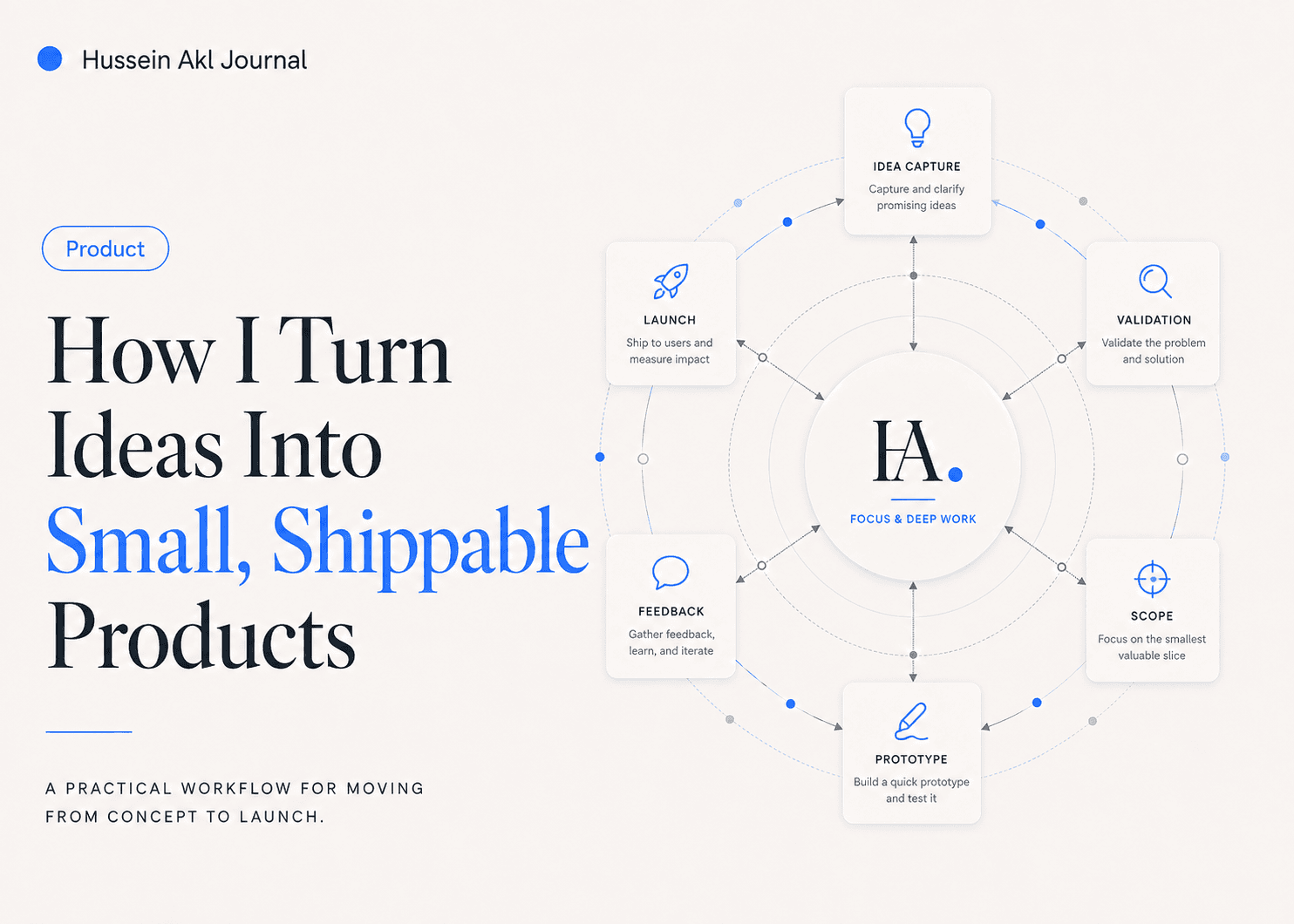
Ideas become difficult when I let them expand before they have earned the right to expand. I prefer to make the first version smaller than my imagination wants it to be.
I capture the idea before I build it
The first step is not development.
It is writing down the problem, the intended user and the smallest useful outcome.
That forces me to separate the idea from the excitement around it.
A product idea can sound impressive because of everything it might become. I want to know whether the simplest version is still worth using.
I identify one core action
Most useful small products can be reduced to one important action.
Clean this link. Inspect this font. Capture this color. Extract these assets. Block this behavior. Show this information.
The first version should make that action reliable.
Everything else competes with it.
I remove the future
I deliberately ignore many questions at the beginning.
What if it has teams? What if it needs accounts? What if it becomes a platform? What if users want advanced settings?
Those questions may matter later.
But they are dangerous before the basic product has proved itself.
I try to build for the current problem, not the imaginary company around it.
I make the prototype real enough to test
A prototype should answer a question.
Sometimes that requires code. Sometimes a clickable interface is enough. Sometimes a rough internal script can reveal whether the workflow is actually useful.
I avoid polishing the wrong layer too early.
The goal is to reduce uncertainty.
I define a shipping line
Projects expand forever unless I decide what “enough” means.
Before the first release, I define a shipping line:
- Core action works
- Obvious errors are handled
- Interface is understandable
- Required permissions are justified
- Essential support and privacy material exists
- The product can be explained honestly
Anything beyond that can become the next version.
I let real use create the roadmap
A roadmap built before users exist is mostly imagination.
After shipping, the product starts generating better information.
Where do people hesitate? Which feature do they repeat? What breaks? What do they ask for? Which assumption was wrong?
Those signals are more useful than brainstorming a giant feature list.
Small projects create learning loops
The reason I like small projects is not only speed.
They create complete loops.
I can move from idea to design to build to launch to feedback quickly enough that the lessons stay connected.
That improves judgment.
The next project benefits from the previous project because the cycle actually finished.
I keep the option to stop
A small first version also protects me from sunk cost.
If the idea is not useful, I can stop.
If the maintenance is worse than the value, I can stop.
If the product belongs inside another product, I can merge it.
Shipping a small version creates options.
Overbuilding early removes them.
The workflow
The process I keep returning to is:
- Capture the problem
- Define the user
- Identify one core action
- Remove future features
- Prototype the uncertain part
- Set a shipping line
- Release
- Learn from real use
- Decide whether the project deserves another version
The objective is not to build less forever.
It is to build enough to learn what deserves to become more.