How I Organize Multiple Brands Without Making Them Feel Disconnected
The goal is not visual sameness. It is strategic coherence.
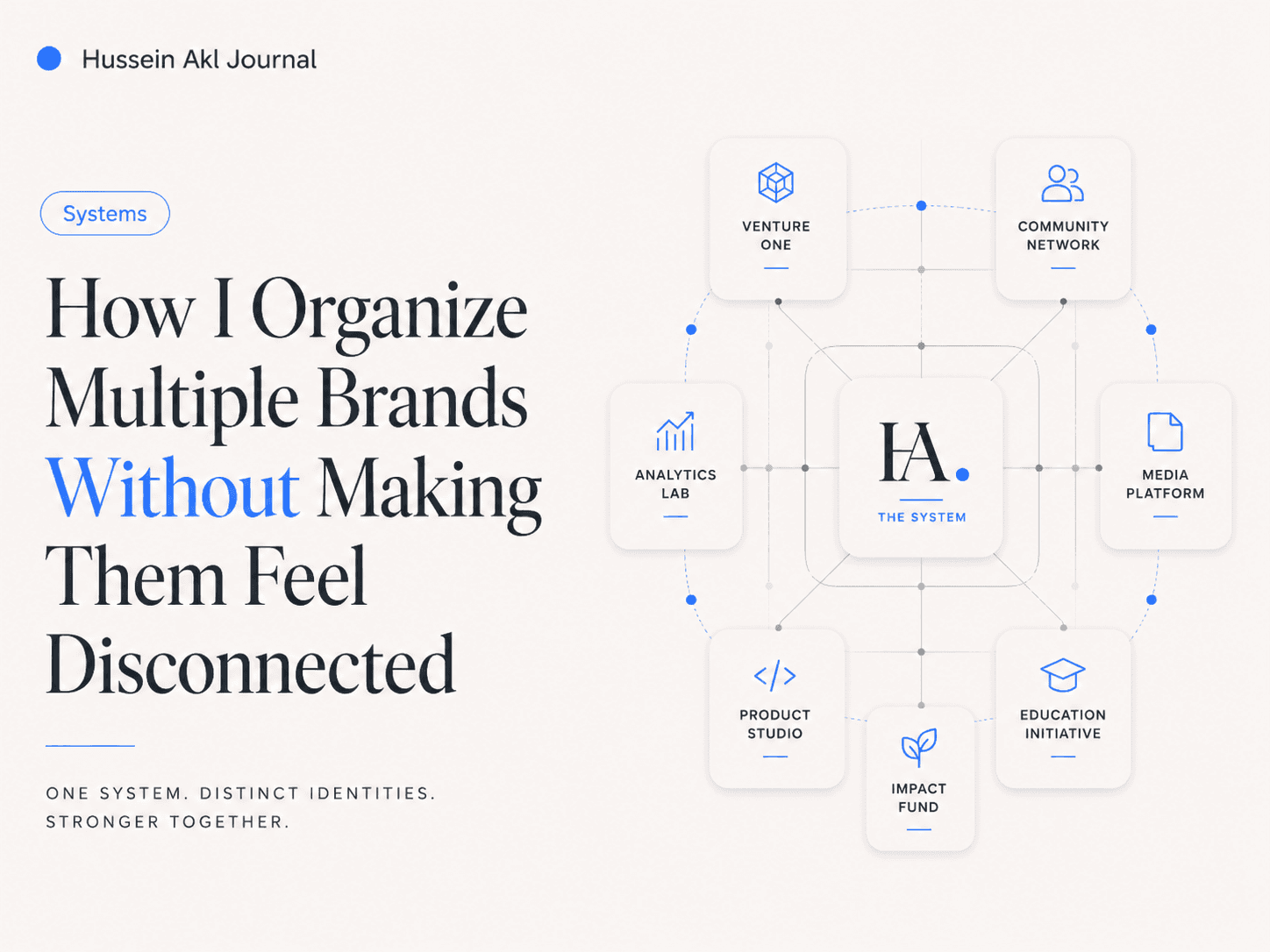
Multiple brands become difficult when the owner tries to solve coherence with sameness. I prefer a different approach: keep the logic shared, but let each brand earn its own expression.
Start with roles, not visuals
The first question I ask about any brand in a larger system is not what color it should use. It is what job it performs.
A role should be easy to state in one sentence. If the sentence is vague, the brand is probably vague too.
For example, a creative studio and a software product can share the same founder without sharing the same audience, buying decision or tone. Trying to visually force them together can make both weaker.
The structure becomes clearer when each brand owns a specific promise.
Define what must stay shared
Once the roles are clear, I define the things that should travel across the ecosystem.
These are usually principles rather than assets:
- Clarity before decoration
- Useful systems over unnecessary complexity
- A direct, human voice
- Strong attention to presentation
- Products and services that solve a recognizable problem
Those principles create familiarity even when the logos, colors and interfaces are different.
Give each brand permission to be specific
A connected brand system should not look like a template duplicated ten times.
The identity of each brand should respond to its context. A professional services studio may need restraint and confidence. A playful browser utility can afford a simpler name and a more expressive icon. A productivity brand may need calmness and structure.
Specificity is what makes the brands useful.
The parent system should provide boundaries, not a uniform.
Use the personal brand as the map
The personal website is where I make the relationships explicit.
Instead of hiding the fact that several projects come from the same person, I use that connection as context. The personal brand becomes the map of the ecosystem.
That means a visitor can discover a studio, a product or a writing project independently, then understand how it connects to the wider body of work when they want more context.
This is one reason I call the section on my site Worlds. The word is broad enough to include businesses, projects and evolving ideas without pretending they are all companies.
Keep the naming logic flexible
I do not force every brand into the same naming convention.
Some names benefit from a family relationship. Others are stronger when they can stand alone.
What matters more is whether the user understands the product and whether the connection is documented somewhere sensible.
A naming system should help memory. It should not become a rule that produces awkward names.
Create operational links behind the scenes
Visual independence does not mean operational isolation.
Behind the scenes, the brands can share infrastructure, knowledge, processes and tools. A lesson learned while building one product can improve the next. A content system can support multiple brands. A shared media library can prevent repeated work.
This is where the ecosystem becomes more than branding. It becomes an operating advantage.
Watch for overlap
The system needs regular pruning.
When two brands begin serving the same audience with similar offers, I have to decide whether they still deserve separate identities.
The right answer may be to merge, reposition or retire one of them.
Architecture is not permanent. It should change as the work changes.
A simple test
I use three questions when reviewing the system:
- Can I explain the role of this brand without mentioning the others?
- Can I explain how it connects to the larger ecosystem in one sentence?
- Does its separate identity make the experience clearer for the audience?
If the answer to all three is yes, the separation is probably useful.
The objective is not to make every brand look related at first glance. The objective is to make the entire system understandable once someone starts exploring it.