How I Decide What Deserves to Be Built
Good ideas compete for the same limited resources: time, energy, attention and maintenance.
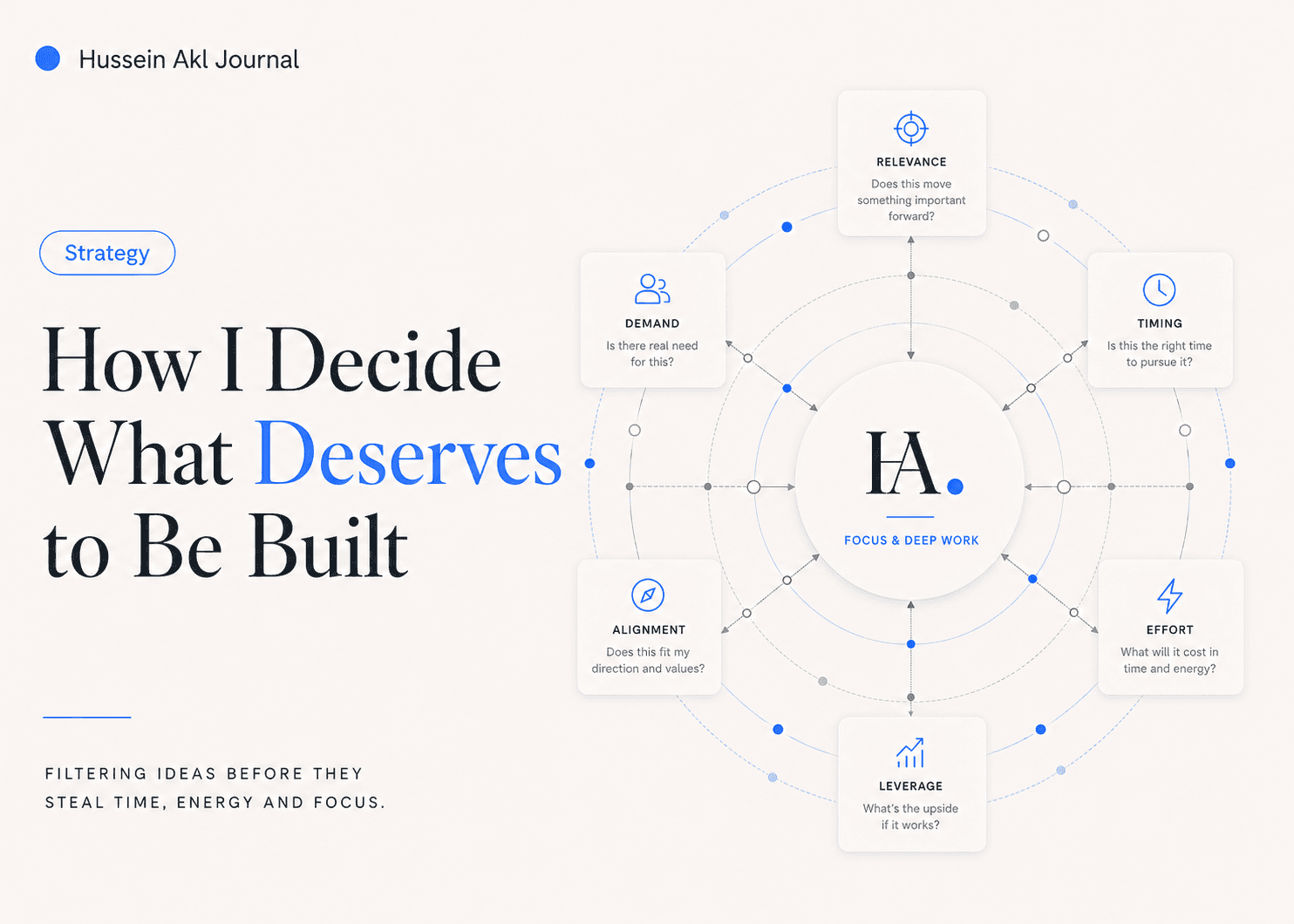
The hardest part of having many ideas is not finding something interesting to build. It is accepting that most interesting ideas should not become active projects at the same time.
I start with relevance
An idea can be good and still be wrong for now.
I ask whether it moves something important forward.
Does it support a current direction? Does it strengthen an existing world? Does it solve a problem I repeatedly encounter? Does it create useful learning?
Relevance prevents me from evaluating ideas only by excitement.
I look for real demand
Demand does not always mean a large market.
It means evidence that the problem exists outside my imagination.
That evidence might come from:
- My own repeated workflow
- Client requests
- Search behavior
- Existing products
- Community questions
- People already paying for imperfect solutions
I do not need perfect validation, but I want more than novelty.
I consider timing
Some ideas deserve to be built later.
The dependencies may not exist. The audience may not exist. The current project may need to ship first. The maintenance burden may be too high right now.
Timing is a strategic constraint.
A delayed good idea can remain good. A badly timed good idea can become expensive.
I look at leverage
I ask what becomes easier if the project works.
Does it create reusable infrastructure? Does it open a new distribution channel? Does it support several existing projects? Does it reduce repeated manual work? Does it create a new capability I can reuse?
Leverage makes a small project strategically larger than its surface area.
I calculate the hidden cost
The build cost is obvious.
The hidden cost is what happens after launch.
Support. Updates. Compatibility. Content. Documentation. Store requirements. Customer expectations. Security. Mental overhead.
A project has to justify ownership, not just development.
I check alignment
An idea should fit either my current direction or a deliberate new direction.
If it requires a completely different audience, brand, infrastructure and operating model, the threshold should be higher.
Novelty is not enough reason to fragment the ecosystem.
I keep a backlog so rejection is not permanent
Saying “not now” becomes easier when the idea has somewhere to go.
The backlog removes the pressure to act immediately.
Some ideas improve while they wait because related projects create new context.
Some ideas quietly stop mattering.
Both outcomes are useful.
The filter
The questions I use are:
- Is this relevant to what I am trying to build?
- Is there evidence of real demand?
- Is this the right time?
- What leverage does success create?
- What ongoing cost does ownership create?
- Does it fit the larger direction?
The goal is not to find certainty.
The goal is to protect attention from ideas that are attractive but strategically weak.