From Notes to Launch: My Workflow for Shipping
A project becomes easier to finish when each stage reduces a different kind of uncertainty.
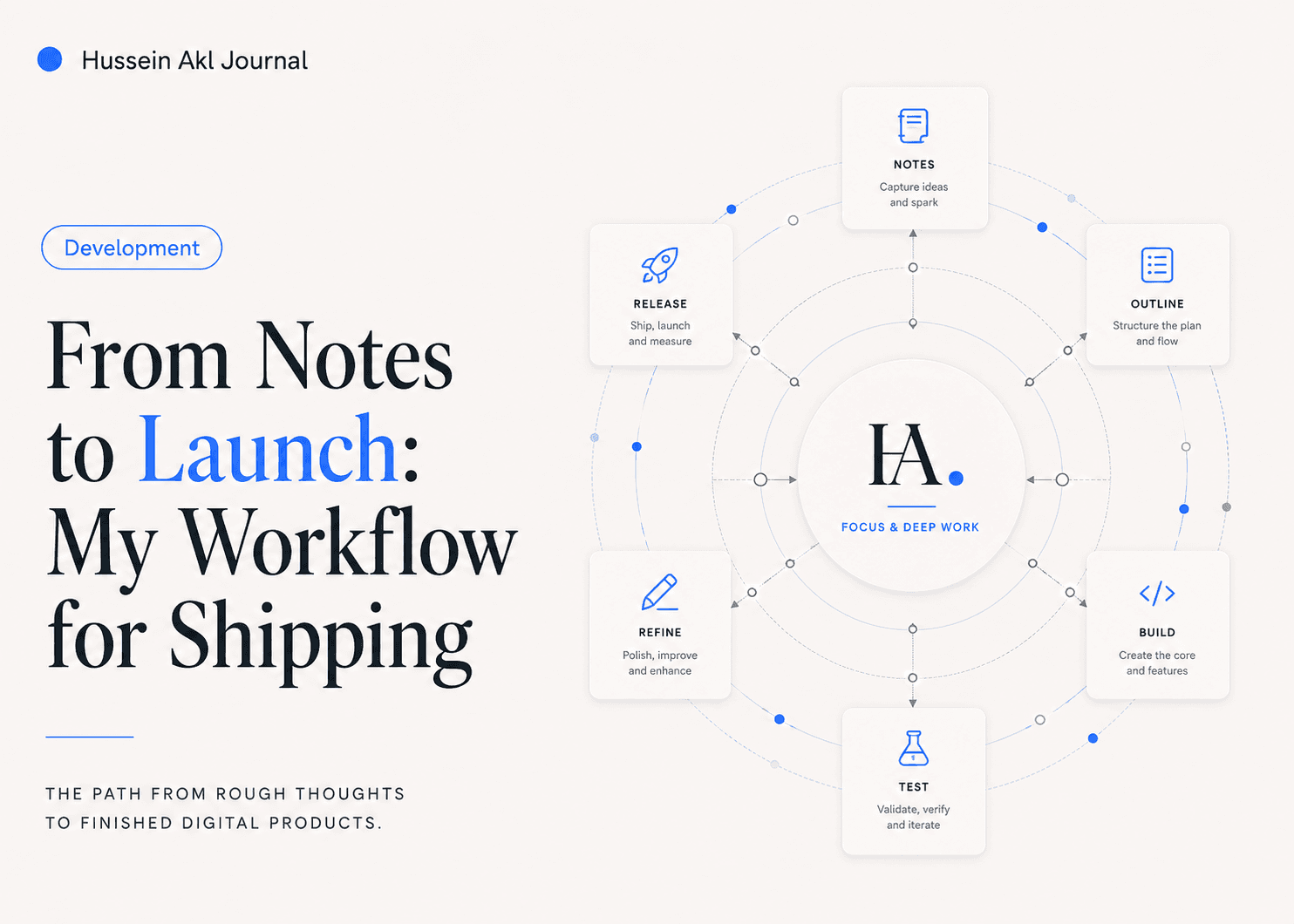
Most of my projects begin as fragments: notes, screenshots, references, complaints, rough sketches and sentences that describe what I wish existed. Shipping requires turning that messy material into a sequence.
Stage 1: capture
I capture before I organize.
The first objective is not structure. It is preservation.
I save the problem, references, screenshots, possible features and any useful context while the idea is fresh.
Trying to organize too early slows capture and makes me less likely to save the raw material.
Stage 2: clarify the outcome
Before building, I define what a successful first version should allow someone to do.
That sentence becomes the project center.
It helps me remove ideas that are interesting but unrelated.
It also makes the later launch copy easier because the product has a clear promise before the interface exists.
Stage 3: outline the flow
I sketch the user journey or working sequence.
What happens first? What information is needed? What state changes? What happens when something fails? What is the final useful result?
I do not need every detail.
I need enough structure to see the product as a flow instead of a collection of screens.
Stage 4: build the core
I build the uncertain or valuable part first.
The goal is to prove the workflow, not decorate the shell.
If the core interaction is weak, visual polish will not save it.
If the core interaction works, the rest of the product becomes much easier to prioritize.
Stage 5: test the real conditions
I try to test outside the ideal scenario.
Different pages. Different inputs. Empty states. Long content. Bad data. Restricted permissions. Unexpected user behavior.
The environment usually reveals assumptions that the clean prototype hid.
Stage 6: refine the experience
Once the core works, I improve the parts that make the product feel trustworthy.
Copy. Spacing. Error states. Loading. Keyboard behavior. Scrolling. Icons. Responsive behavior. Accessibility. Privacy explanations.
This polish is not decorative.
It reduces uncertainty for the user.
Stage 7: prepare the launch surface
The product needs an explanation.
I prepare the landing page or store listing, screenshots, support information, privacy details and any documentation the user needs.
This stage often exposes product confusion.
If I cannot explain a feature clearly, the feature may still be unclear.
Stage 8: release
I prefer a real release over a perfect private build.
A released version produces information that internal testing cannot.
The important thing is that the first release is honest about what it is.
Small is fine. Incomplete is fine if the core promise is complete. Broken is not fine.
Stage 9: learn
After launch I collect what actually happens.
Which questions repeat? Where do users stop? What is misunderstood? What breaks? What is used more than expected?
Those observations become the next planning layer.
The workflow is a loop
The process is not linear forever.
After release, the product returns to notes.
New feedback becomes capture. Capture becomes another decision. The next version starts with better information.
That is the workflow I want: not endless planning before launch, but repeated cycles where every shipped version makes the next decision more informed.