Designing Products When You Are the Designer, Marketer and Developer
Wearing every role can accelerate decisions, but only if you stop each discipline from competing for control.
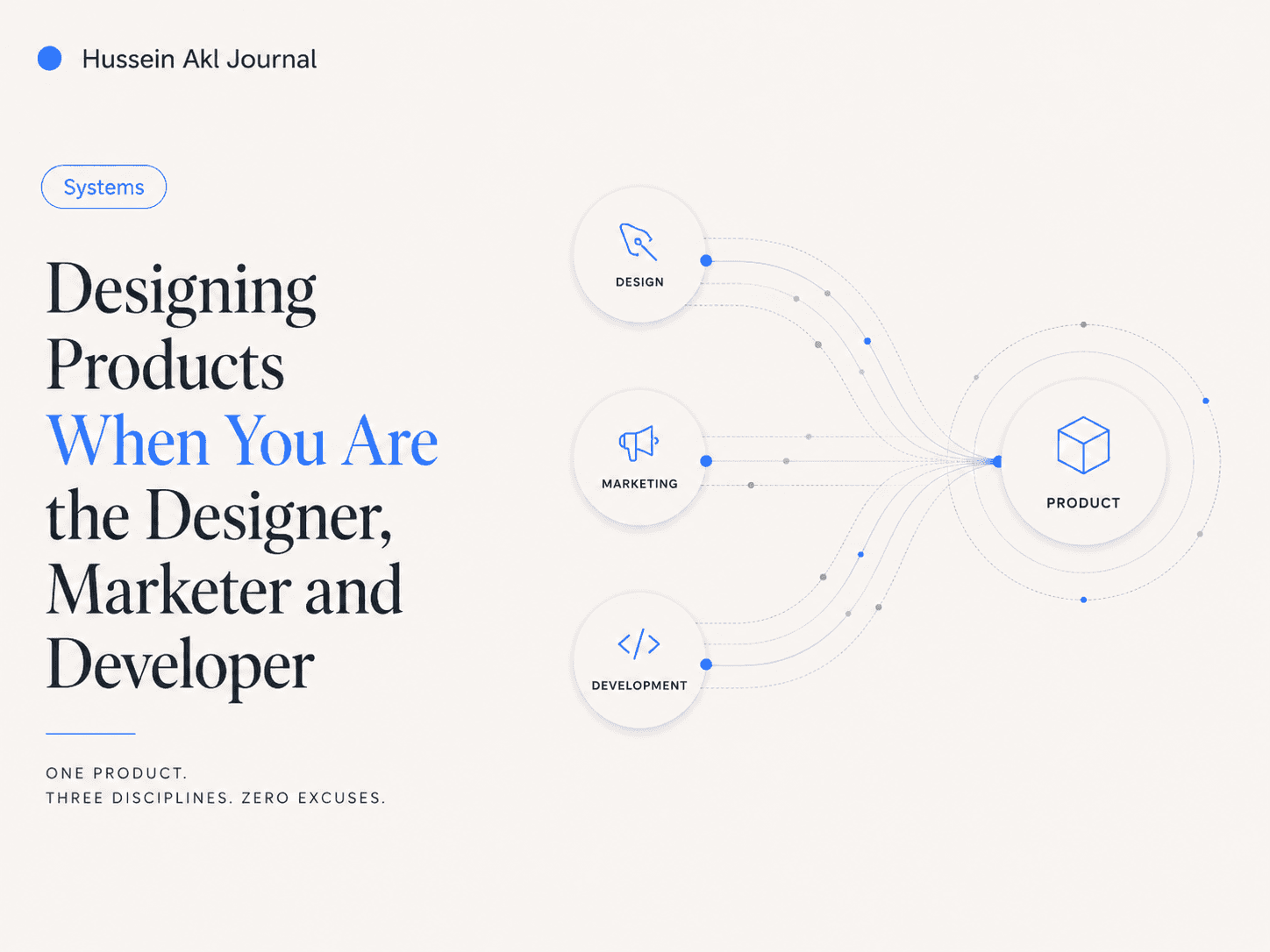
Working across design, marketing and development gives me unusual freedom. It also creates an unusual problem: I can create work for myself faster than anyone else can stop me.
One person, three definitions of good
Each discipline looks at the same product differently.
The designer asks whether the experience is clear and coherent.
The developer asks whether it is reliable, maintainable and technically sensible.
The marketer asks whether someone understands why it matters and can find a reason to care.
All three are necessary.
The danger appears when one perspective starts optimizing the product at the expense of the others.
Design can overvalue elegance
As a designer, I can become attached to an interaction because it feels refined.
But if the interaction makes the product harder to explain or requires unnecessary engineering, elegance becomes expensive.
A beautiful feature that users do not need is still scope.
The design has to serve the core action, not the portfolio screenshot.
Development can overvalue possibility
Once I know something can be built, it becomes tempting to build it.
Technical possibility is not product justification.
A feature can be interesting to implement and still make the product worse by adding settings, edge cases or maintenance.
I try to separate the question “Can I build this?” from “Should this exist?”
Marketing can overvalue the story
Marketing creates another temptation: building features because they sound good in a launch post.
A long feature list can make a product look substantial while making the actual experience heavier.
The strongest marketing usually comes from a clear product, not from adding things to create more talking points.
I use one product promise as the referee
The simplest way I have found to align the disciplines is to write the product promise early.
What is the user trying to accomplish, and what should this product make easier?
When a design decision, technical feature or marketing idea conflicts with that promise, the promise wins.
That does not remove judgment, but it gives the judgment a center.
Sequence the roles
I also try not to perform all three disciplines at once.
During problem definition, I think like a product strategist.
During interaction design, I prioritize clarity.
During implementation, I focus on reliability and scope.
During launch preparation, I switch toward explanation and distribution.
The same person can wear multiple hats, but switching constantly creates noise.
Create stopping rules
Solo work lacks an external person saying enough.
So I need explicit stopping rules.
For a first release, I might define:
- One core workflow must be complete
- Critical errors must have understandable states
- The interface must work at intended sizes
- Permissions and privacy must be clear
- The listing or landing page must explain the product
- Nice-to-have features move to a later list
These rules protect the project from endless improvement.
The advantage of being multidisciplinary
There is a real upside.
I can spot connections between disciplines quickly.
A confusing marketing sentence may reveal a product problem. A difficult interface may reveal that the feature is too broad. A technical limitation may lead to a simpler and better interaction.
The feedback loop is short because the disciplines are close together.
The constraint I want to keep
I do not think the goal is to become equally expert at every role.
The goal is to understand enough of each discipline to make better tradeoffs.
A product is one experience. Users do not experience the design, code and marketing as separate departments.
When I work alone, that becomes impossible to forget.
The challenge is making sure the freedom of doing everything does not become the excuse to build everything.