Building in Public Without Losing Your Focus
Sharing progress can create accountability and connection, but only if the work stays more important than the performance of the work.
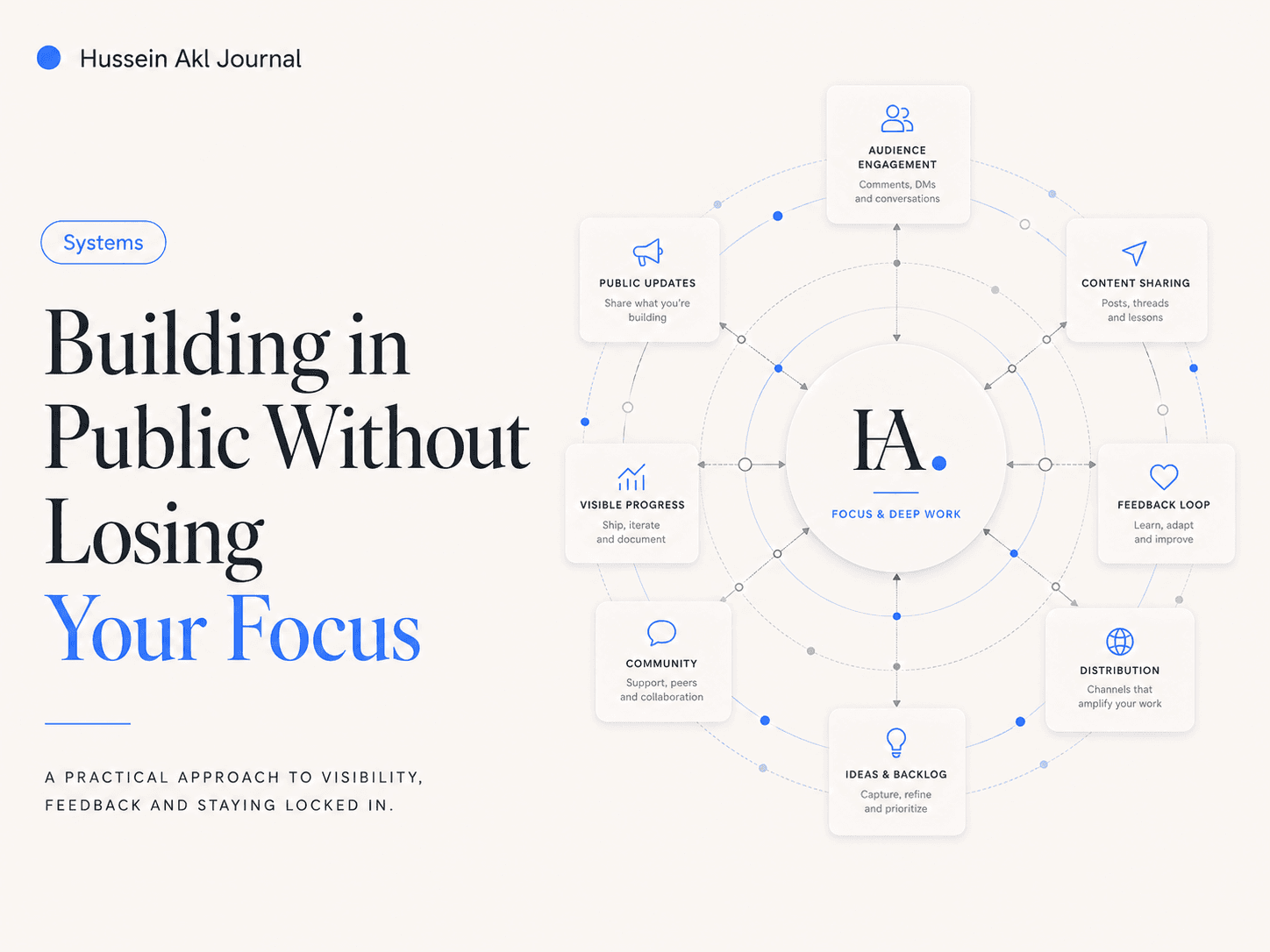
Building in public is useful because it creates visibility around work that would otherwise stay invisible. But visibility can quietly become another project to manage. I want the benefits of sharing without letting the act of sharing replace the work itself.
The useful side of building in public
Sharing work while it is still evolving can create momentum.
It gives people context before a launch. It makes the process visible. It creates opportunities for feedback, conversation and unexpected connections. It can also make a solo project feel less isolated because progress is no longer happening entirely in private.
For someone building multiple products, brands and systems, that visibility can compound. One project can introduce another. One lesson can become an article. One public experiment can attract the exact person who understands why the work matters.
That is the part I value.
The danger is performing progress
The problem begins when sharing becomes more rewarding than doing.
It is possible to spend an hour explaining a feature that took twenty minutes to build. It is possible to design a beautiful progress update about a project that is still structurally weak. It is possible to create the appearance of momentum without creating much momentum at all.
I try to notice that distinction early.
The work should produce the content. The content should not force the work to exist.
I do not share everything
Building in public does not mean publishing every thought.
Some ideas need privacy while they are still fragile. Some decisions are easier when they are not being evaluated in real time. Some projects are better revealed when enough of the system exists for the audience to understand what they are seeing.
I like selective transparency.
I can share the direction, the lesson or the result without publishing every unfinished internal detail.
I separate audience promises from experiments
One of the biggest risks of public building is accidental commitment.
The moment an idea is named, branded and announced, it can start to feel like a promise.
That is why I distinguish between:
- Something I am exploring
- Something I am actively building
- Something I intend to ship
- Something that is already available
The language matters.
An experiment should be allowed to disappear. A public commitment should be treated more seriously.
I use sharing as documentation
The most useful public updates often begin as private documentation.
What changed? Why did I make that decision? What failed? What became simpler? What surprised me?
Those notes can later become posts, articles or launch material.
This makes sharing more efficient because I am not inventing a content layer from scratch. I am translating work that already happened.
I protect deep work from distribution
There are periods where the best thing I can do for a project is disappear for a while.
Distribution is important, but it introduces context switching. Replies, analytics, formatting and publishing all pull attention away from the problem I am trying to solve.
So I prefer to batch visibility around meaningful milestones instead of narrating every hour.
The project needs uninterrupted time before it needs an audience.
What I want people to see
I am less interested in proving that I am busy than in showing how I think.
A useful public update should reveal something real:
- A decision
- A tradeoff
- A lesson
- A system
- A result
- A mistake that changed the direction
That creates more durable value than a constant stream of “still working on this” updates.
The rule I keep coming back to
If sharing the project starts slowing the project, I reduce the sharing.
That sounds obvious, but it is easy to forget when visibility feels productive.
Building in public should create leverage around the work. It should not become another layer of work that the project must support.
The project comes first.
The public story is valuable because there is something real underneath it.